How Long to Do Companies Keep Hr Records q how to Work for a Company Again That You Dismissed From
Employees ink a lot of paperwork when they're hired, and the flow of documents continues throughout their tenure with your company. Inside that period there are private documents, legal documents, signed and unsigned documents, and some documents you may not even need.
An employee'due south personnel file is an official visitor record. In some states, electric current and former employees have the right to see their personnel files.
Federal agencies such as the Internal Revenue Service or U.S. Citizenship and Immigration Services (USCIS) may besides request documents in your personnel files. Your records may too exist required to answer a lawsuit.
When that happens, you don't want to go searching and wondering what to exit in and what to leave out.
With many employee forms migrating to electronic document systems, information technology'due south more important than always to accept a plan for filing, retaining, and storing employee documents.
A human resources (HR) document retentivity policy tin can ensure that you always have current, accurate, and relevant papers right where y'all can notice them. Information technology also lets y'all have advantage of the intelligence buried in all that paperwork.
Overview: What files should yous accept on each employee?
Information technology'south important to document an employee'due south record of employment, first all the way back to the recruiting and hiring procedure. Many employers are surprised to learn that they must keep records of task applicants as well equally hires in instance of a bigotry complaint.
Hr software can collect this information and even crunch the numbers and run reports for you. Then you tin work proactively as your ain watchdog, checking for unintentional bias and fine-tuning your recruiting and hiring practices.
The importance of maintaining HR records continues equally your employee stays on yr after yr. For example, say y'all have an employee with serious performance issues. You create a performance improvement plan, merely the problems continue. Somewhen, you finish the employee.
That trail of functioning appraisals and progressive subject field prepares the employee and backs your decision in example the terminated employee complains. One again, careful paperwork tin can reinforce Hour best practices.
Proper HR document management is besides important to protect your employees' sensitive information. Personal identifying information, financial documents, and health records must be deeply stored. Mismanaging this information can harm your employees and crusade legal bug for your company.
How long should you keep employees files and records?
Once an employee leaves your company, the clock on record retentivity starts. Knowing how long to retain records and which records you tin can archive or destroy is of import to maintaining a manageable, efficient, compliant employee document repository.
This chart shows the employee documents y'all should maintain for job applicants and employees, along with minimum retention requirements following their separation or rejection from employment. Many legal and fiscal advisors recommend retaining documents for longer periods.
It'due south OK to set longer horizons for disposing of documents. The of import thing is to bargain with them consistently across all Hr processes.
Chart of the employees' files and records:
| Record Type | Minimum Retentiveness Period |
|---|---|
| Job advertisements, position descriptions, resumes, application forms, and nonmedical screening tests for all applicants | 3 years under ADEA |
| Background checks, credit reports, and fiscal records | 1 year with secure storage and disposal |
| I-9s and copies of forms of identification (IDs) | 3 years after hire or 1 yr after separation in a secure, split file with all employee I-9s |
| Employment offers and contracts, employee handbooks, and other signed documents | one twelvemonth |
| Medical records, wellness insurance enrollment forms, disability records, accommodation requests, medical exams, doctors' notes, and drug test results | 1 yr with separate, secure storage and disposal |
| Operation appraisals, disciplinary records, awards, and attendance records | 2 years |
| Payroll records, Due west-4s, and time cards | 4 to vii years |
| Separation records including get out interviews, reasons for termination, termination or resignation letters, severance agreements, and other separation agreements | ane year |
| Nonmedical benefit plans, offers, and records | 1 twelvemonth |
| FMLA exit requests and documentation | 3 years |
| Accident and injury records | 5 years |
| Hazardous exposure records | 30 years |
| Complaint and investigation documents | Until the claim is resolved |
ane. Recruiting materials
You demand to retain documents on applicants and hires to ensure that y'all're not discriminating against qualified candidates. Championship VII of the Ceremonious Rights Act (Championship Seven) requires yous to keep records for one year, only the Age Discrimination in Employment Human action (ADEA) requires iii, then y'all'll need to comply with the higher standard.
Discrimination can be intentional or caused past policies with a "disparate bear upon" on protected employees. For example, you may require an English literacy test for employees who don't need advanced English skills, a practice that disproportionately eliminates candidates based on national origin.
ii. Background checks
If you run criminal background checks or credit checks, tread cautiously. Title 7, the Off-white Credit Reporting Human action (FCRA), and other federal laws limit your right to use this information and require that you securely store and destroy it.
iii. I-9s
Go along I-9s for all employees in a secure, separate file in case of a review by the USCIS. You need to keep just pages with signatures.
Yous're responsible for IDs, but you don't have to copy them. If y'all exercise copy IDs, you lot must do then consistently for all employees, store them securely, and destroy them when the retention period ends.
iv. Employee contracts
All signed contracts should be kept in your employees' personnel files to document your policies and agreements. This is of import for defending your company from complaints and lawsuits. If new contracts replace old ones, keep the current copy in the file and destroy the old version.
5. Medical information
Medical and genetic information about your employees and their family unit members must be stored deeply under the Americans With Disabilities Deed (ADA), the Genetic Data Nondiscrimination Human action (GINA), and wellness standards overseen past the Occupational Rubber and Health Administration (OSHA).
This includes doctors' notes, accommodation requests for medical conditions, and other medical data provided by employees.
6. Performance appraisals
Keep all performance assessments and disciplinary records on file for at to the lowest degree two years. This documentation can protect you in instance of complaints regarding promotions and bounty. It also supports all-time practices in managing employees consistently, fairly, and legally.
7. Payroll records
Time cards and other payroll records must be stored for two to three years to comply with antidiscrimination and wage and hour laws such as the Off-white Labor Standards Deed (FLSA) and Age Discrimination in Employment Act (ADEA).
The IRS, however, requires payroll tax records to exist stored for four years, and state taxation laws may prescribe an even longer retention period. To be rubber, information technology's all-time to store all of these records for seven years.
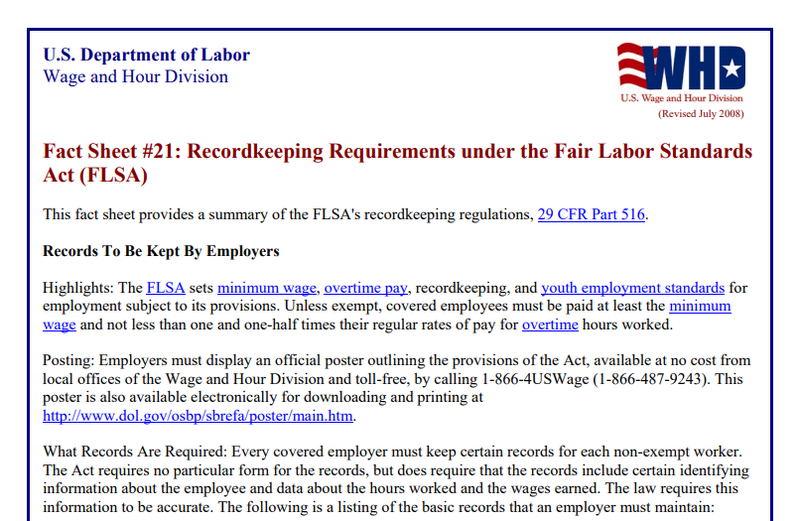
Employee records are protected by a network of state and federal laws such every bit the FLSA. Source: dol.gov.
8. Separation records
Under antidiscrimination and wage and hour laws, all documents concerning an employee'southward resignation or termination should be kept for one year subsequently separation from employment.
9. Benefit records
Nonmedical benefit records including enrollment forms and plans may be discarded after i year. Y'all must take steps to protect employees' financial or personal identifying data, and then some of these records may crave secure storage.
ten. FMLA exit
The FMLA requires employers to retain leave requests for at least three years, including documentation of reasons for leave. Any records with medical information must be stored securely.
11. Accident and exposure records
OSHA requires employers to deeply store records of accidents for v years. Workplace exposure to hazardous substances must be retained for 30 years considering of potential long-term health effects.
12. Complaints
Anytime an employee complains or files a lawsuit, you must retain related records until the merits is resolved. Your document direction system should put an automatic agree on an employee'south personnel file following a complaint to avoid accidentally destroying whatsoever relevant documents.
Legal implications of modest business concern record-keeping
Failing to store and secure employee records can be costly. Potential fallout includes:
Citations and penalties: OSHA, the U.South. Section of Labor, the IRS, and other federal agencies, equally well every bit state government, enforce tape-keeping requirements with citations and fines. For example, tape-keeping errors are the second-nigh common violation cited by OSHA. The maximum penalty for a violation was raised to $13,494 for 2020. Failing to keep documents such as payroll records can even lead to criminal charges.
Legal liability: If an employee sues and you can't produce records required by the court, you could lose the lawsuit and confront additional charges of spoliation of testify. An case is an Illinois case, Mohr v. Weather Tech, in which the company discarded an employee's calendar after her termination for excessive absences. The employee sued for discrimination and the agenda was requested during discovery. When the company couldn't produce it, the employee filed a negligent spoliation merits. In this example, the employer won, but that's a lot of time, money, and grief spent over a missing calendar.
Take charge of employee records
A comprehensive Hour record management plan lets yous direct the catamenia of employee data through your company to serve your ends.
In addition to ensuring legal compliance, conscientious records management can provide insights to drive Hr policies, protect your employees' sensitive information, and reinforce Hour best practices.
The Motley Fool has a Disclosure Policy. The Author and/or The Motley Fool may take an interest in companies mentioned.
earnestcorties1937.blogspot.com
Source: https://www.fool.com/the-blueprint/how-long-to-keep-employee-files/
0 Response to "How Long to Do Companies Keep Hr Records q how to Work for a Company Again That You Dismissed From"
Post a Comment